
Page One on Google and Cited by AI Overviews, Yet a 2.1% Click-Through Rate ── SEO, AEO and GEO Lessons from an International Patent Office Website
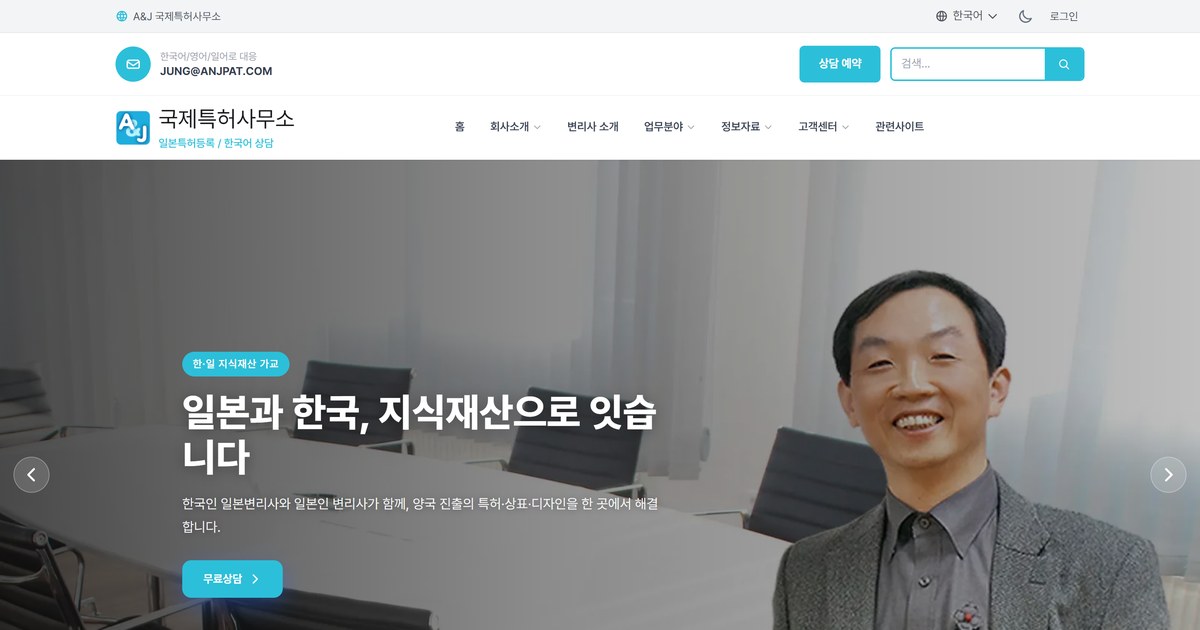
A&J International Patent Office (anjpat.com) in Minato City, Tokyo, is a firm where Korean-born and Japanese patent attorneys, all licensed in Japan, help clients file patents, trademarks and designs in Japan and Korea. THEVOS builds and operates its website. In this article we look at the site's search performance using real figures from Google Search Console, and walk through the SEO, AEO and GEO review and improvements we carried out in a single day on September 13.
To put the conclusion first: the site was already highly rated, ranking on the first page of search results and cited as a source in Google's "AI Overviews." Even so, its click-through rate stood at just 2.1%. There were issues that rankings alone could not reveal.
1. Search performance over three months
These are the figures recorded in Google Search Console for the last three months (through September 12).
| Item | Figure |
|---|---|
| Times shown in search results | 5,429 |
| Clicks | 113 |
| Average click-through rate | 2.1% |
| Average position | 8.5 |
| Distinct search queries shown | 151 |
An average position of 8.5 means the site generally appears in the lower half of the first page of results. For "일본 변리사" (Japanese patent attorney), the query the firm's core clients actually type, it averages position 1.9 — effectively the top spot.
| Query | Impressions | Click-through rate | Average position |
|---|---|---|---|
| 일본 변리사 (Japanese patent attorney) | 90 | 6.7% | 1.9 |
| a&j | 82 | 6.1% | 2.0 |
| 디자인 출원 비용 (design application cost) | 2 | 50% | 12.5 |
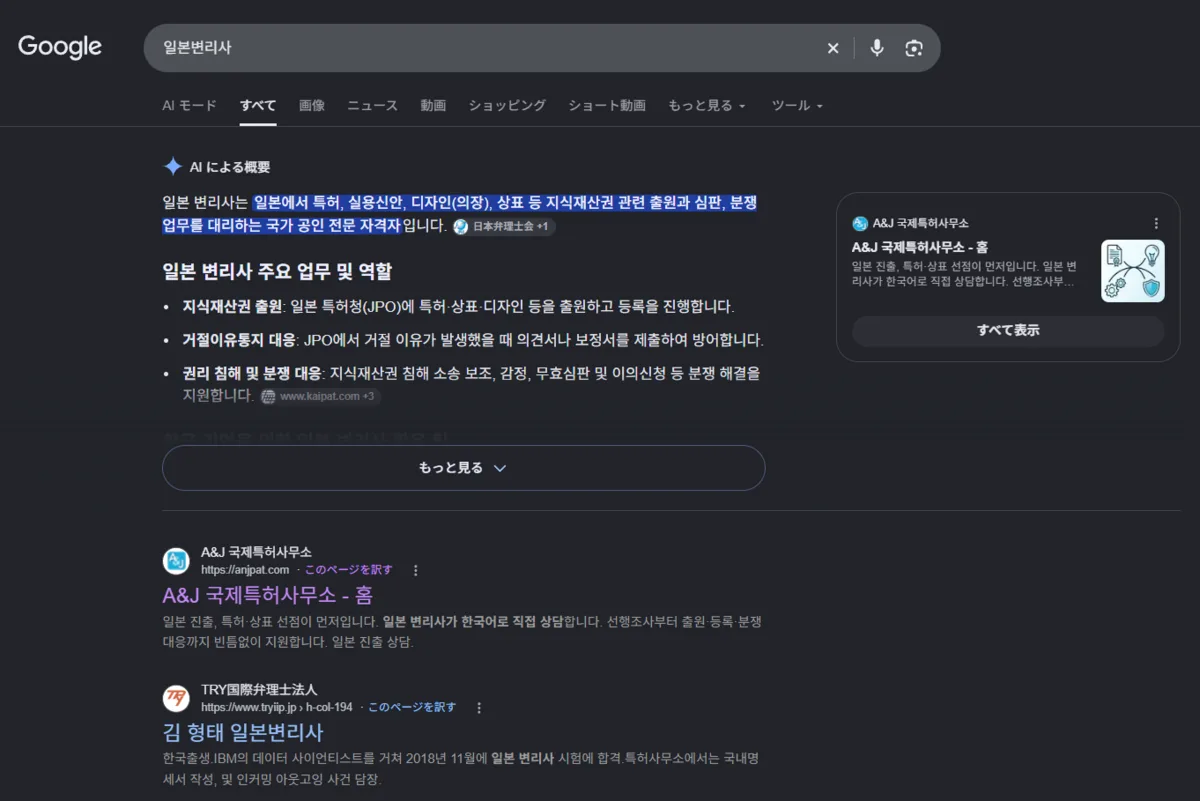
On rankings alone, there is nothing to fault. But a click-through rate of 6–7% from the top two positions is low. It means that more than nine out of ten people who saw the result clicked on another site.
2. Google's AI Overviews chose this site as a source
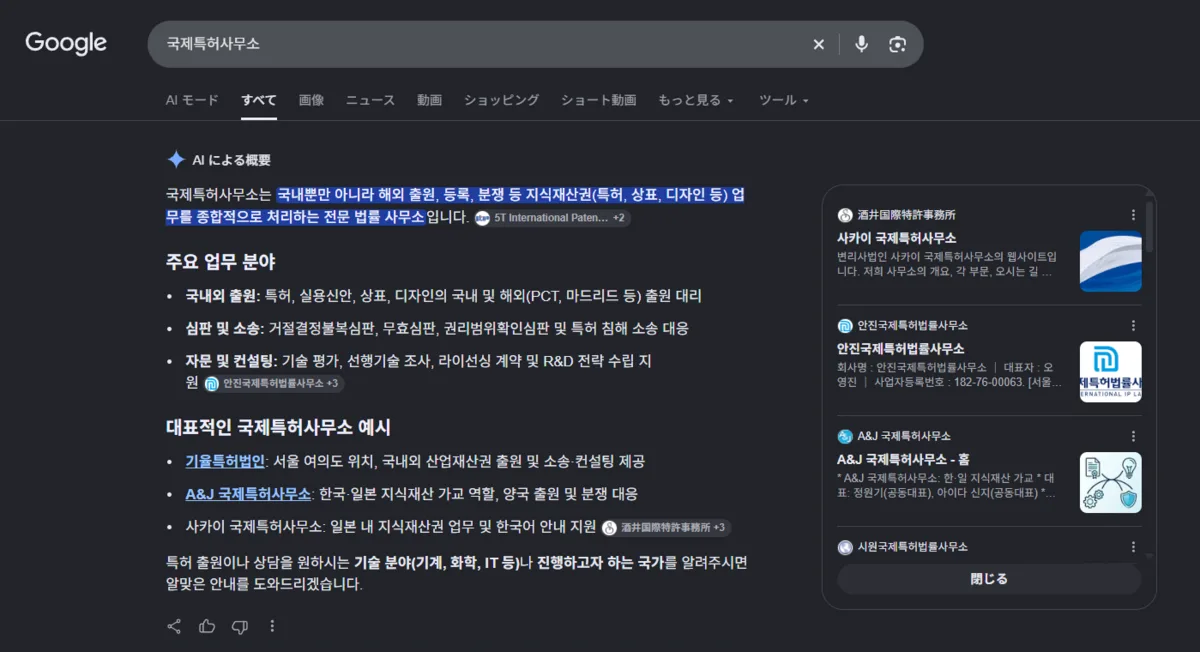
When we searched Google for "국제특허사무소" (international patent office) on September 13, "A&J 국제특허사무소 - 홈" (A&J International Patent Office - Home) appeared as a source card next to the "AI Overviews" at the top of the page. The card showed the firm's logo, a photo of its representative patent attorney and the tagline "Bridging Korea and Japan in intellectual property." This signals that Google's AI reads anjpat.com as a reliable source when answering this query, and it can be seen as a first result of generative AI search optimization (GEO).
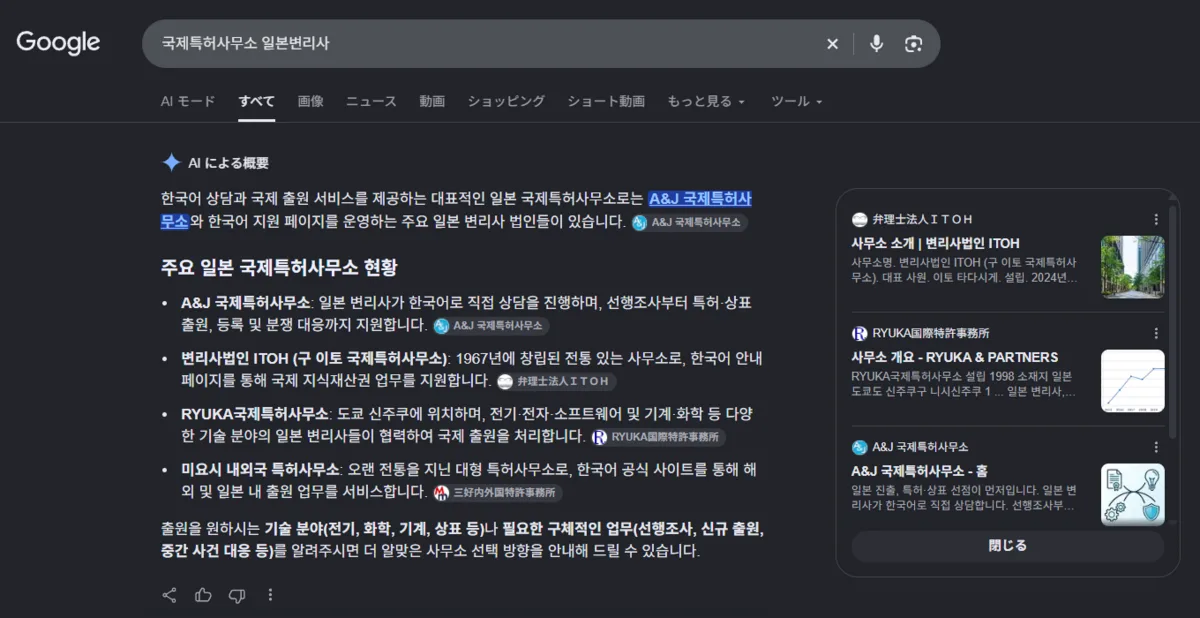
When we searched again on September 14, A&J International Patent Office was named not only in the source card but also in the AI Overviews text itself, among the "examples of representative international patent offices." A search for "국제특허사무소 일본변리사" (international patent office, Japanese patent attorney) produced AI Overviews that introduced A&J International Patent Office first among the leading Japanese firms offering consultation in Korean.
In the regular results, the site was ninth on the first page. Making the first page for a query as broad as "국제특허사무소" is itself a good result. Above it, however, were several Korean-language pages run by Japanese patent firms. They are competitors targeting exactly the same clients as A&J: Korean businesses looking to file in Japan.
There is one caveat here. The screen carried the note "Results are personalized." Google reorders results according to the searcher's location and browsing history. The more often someone visits a site — its developer or the firm's own staff, for example — the more likely it is to appear near the top on their screen. The ranking you see on your own screen is not necessarily the ranking your clients see. That is why we base our judgments on aggregated Search Console data rather than screenshots.
3. Five reasons clicks were being lost
3-1. "홈" (Home) at the end of the title
The title shown in search results was "A&J 국제특허사무소 - 홈" (A&J International Patent Office - Home). The trailing "홈" (Home) tells searchers nothing and wastes valuable title space. The title also said nothing about what makes this firm stand out, such as "Japan," "consultation in Korean" or "Tokyo." Because the site description (meta description) was empty, Google was showing a truncated list of practice areas from the page body instead.
3-2. "PPH": 534 impressions, 0 clicks
Surprisingly, the query with the most impressions was "pph" (460). A page explaining the Patent Prosecution Highway (PPH), a program that speeds up patent examination, was being shown. Add "pph 뜻" (what pph means, 38) and "ㅔㅔㅗ" (36) — what you get when you type "pph" with the keyboard still set to Korean input — and the total reaches 534, about 10% of all impressions. The average position was around 6, yet there was not a single click.
People who type these queries want to know what PPH is and how to apply for it. The title and description shown in the results did not answer that question, so they appear to have clicked on other sites instead. People searching for PPH have patent applications in progress or in preparation — in other words, they are potential clients. This was the most regrettable loss.
3-3. People are looking for costs
"디자인 출원 비용" (design application cost) had only 2 impressions and ranked on page two (12.5), yet one of them led to a click. There is clear demand from people who want to know costs and timelines, but no page answered it.
3-4. Japanese and English pages were invisible to search engines
The site already had Japanese and English translations. However, the language was determined only by a cookie in the visitor's browser. Search engine bots and AI crawlers do not keep cookies, so they always saw the Korean version. Even on the Japanese screen, page titles remained in Korean. Although the site offered information for Japanese companies considering expansion into Korea, its structure meant that information could never appear in Japanese searches.
3-5. Half of the sitemap returned errors
The sitemap, which tells search engines which pages exist, listed 224 URLs, and 114 of them returned "Forbidden (403)." This was because it even included the addresses of consultation request boards that only administrators can view. Google kept returning to addresses it could not open, wasting crawl resources, while errors piled up in Search Console.
4. What we did on September 13
4-1. SEO ── Making sure search engines read the site correctly
- Sitemap cleanup: We changed the sitemap so that it lists only pages anyone can view. All 309 Korean, Japanese and English URLs now respond normally. The root cause was that the sitemap generator in the CMS the site is built on did not check the read permissions of boards. So rather than patching only this site, we fixed and released our own CMS, "VosCMS," itself. Other sites running the same CMS receive the same improvement. After the fix, we resubmitted the sitemap in Search Console.
- Language-specific URLs: We gave each language its own address, such as
?lang=jafor Japanese and?lang=enfor English, and added markers (hreflang) on each page that point to its other language versions. After we translated the site name, page names and even board item names, Korean disappeared entirely from the titles of all 206 Japanese and English URLs. Seven old pages written only in Korean were permanently redirected (301) to pages where the same content is available in translation, so the ranking value they had built up was not lost. - Site description: We rewrote it in Korean, Japanese and English. Within the 80 characters recommended by Naver, the Korean version includes "Korean-born patent attorney licensed in Japan," "consultation in Korean" and "free one-on-one consultation."
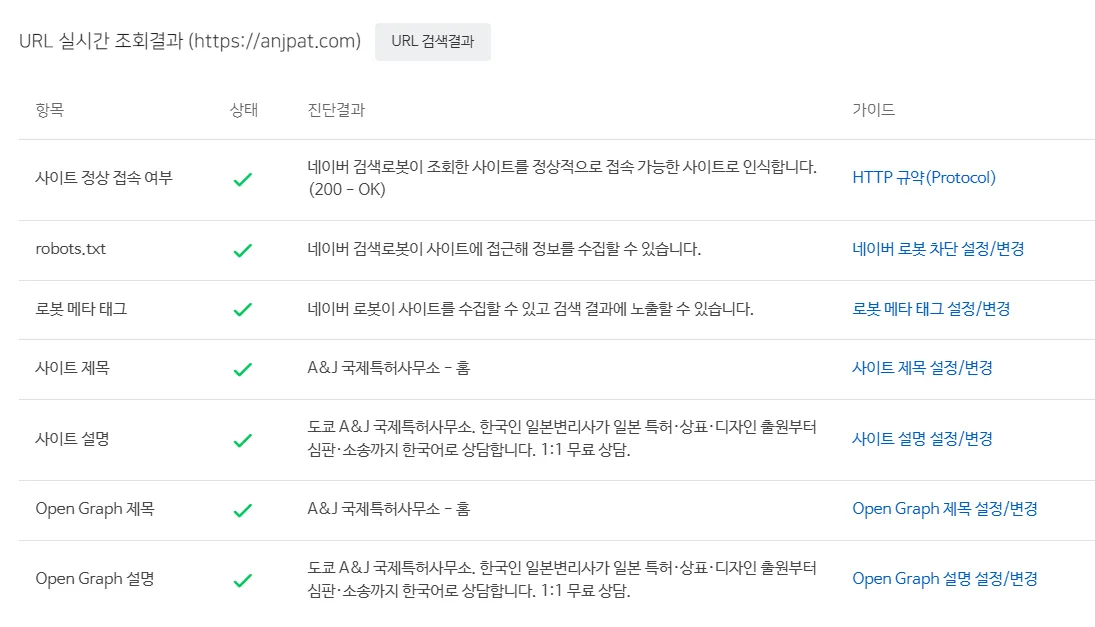
- Naver registration: Korean clients use Naver, Korea's leading search portal, heavily. We registered the site with Naver Search Advisor, submitted the sitemap and requested crawling of the main pages.
- Share previews: We added a representative image (1200×630) and language-specific titles and descriptions that appear when the site's address is shared on KakaoTalk or LINE.
4-2. AEO ── Responding to questions with "answers"
We described ten frequently asked questions in a format (structured data) that search engines can read as question-and-answer pairs, and used the same format to state the firm's name (in each language), its supported languages (Korean, Japanese and English) and its service areas (Japan and Korea). Going forward, we are proposing to add more of the questions clients actually search for, such as "How much does it cost to register a trademark in Japan?" and "How long does it take from filing a patent application in Japan to registration?", and to put the conclusion — the cost, timeline or procedure — in the first sentence of each answer. The more directly an answer leads with its conclusion, the more easily search engines and AI can quote it as is.
4-3. GEO ── So that AI can read and follow the site
- We checked one by one whether the crawlers of major AI services such as ChatGPT, Claude, Perplexity and Gemini can read the site. All of them access it normally.
- A guide file (llms.txt) that summarizes the site in a form that is easy for AI to read is regenerated automatically every time a page is added or edited.
- The language switch buttons ran on scripts rather than real links, so bots and AI agents could not move to the Japanese and English pages. We replaced them with links to real addresses.
- We gave names to the menu close button and the slider buttons, which had none, and passed every check in the "Agentic Browsing" category of PageSpeed Insights (which checks whether AI agents can operate the site).
4-4. Speed ── A first screen that took 22 seconds on phones
On phones, the first screen was taking about 22 seconds to appear. There were three main causes. First, the site was downloading complete font files, using 3.8 MB. We switched to a method that downloads only the characters that are needed, cutting this to 402 KB. Second, the design CSS was being generated on the spot by each visitor's browser. We replaced it with a prebuilt file. Third, we made the large photo on the first screen lighter by converting it to WebP and set it to load first.
| PageSpeed Insights item | Before | After |
|---|---|---|
| Performance (mobile) | 55 | 68 |
| Performance (desktop) | 70 | 94 |
| SEO | 85 | 100 |
| Accessibility | 85 | 91 |
| First screen display (mobile) | About 22 s | About 2.1 s |
| Agentic Browsing | Some checks failed | 3/3 passed |
During the review, we also found that the analytics tool (Google Analytics) was being loaded twice and counting the same visit twice, and we corrected it right away. As a result, visit numbers may appear to drop after September 13, but this does not mean fewer people are visiting — the numbers have simply become accurate. Unless this kind of change is explained in advance, it easily leads to the misunderstanding that "visitors dropped after the site was fixed."
5. Next steps ── Turning rankings into clicks
This work has laid the foundation for search engines and AI to read the site correctly. The next step is to turn the rankings the site already holds into clicks and consultation requests. We are working on the following with the firm.
- Home title change (applied September 14): We changed the title shown in search results from "A&J 국제특허사무소 - 홈" (A&J International Patent Office - Home) to "A&J 국제특허사무소 - 일본 특허·상표 출원 한국어 상담 (도쿄)" (A&J International Patent Office - Japanese patent and trademark filing, consultation in Korean (Tokyo)). The Japanese and English titles now also contain search terms, such as "日本・韓国の特許・商標出願" and "Japan & Korea Patent and Trademark Filing." This is the fastest way to raise the click-through rate for "일본 변리사" and "a&j," where the site already ranks near the top, and it will be reflected in search results once Google recrawls the page.
- Strengthening the PPH page: We will change its title to something like "PPH(특허심사 하이웨이)란? 한·일 PPH 신청 방법" (What is the PPH (Patent Prosecution Highway)? How to apply for the Korea–Japan PPH), answer what it means in a single sentence in the first paragraph, and then set out the eligibility requirements, procedure and timeline. The goal is to turn those 534 impressions into clicks.
- Cost and timeline guide: We will create a guide that sets out the costs and timelines of patent, trademark and design applications in Japan in tables, aiming to reach the first page for cost-related queries.
- Checking the results: Two weeks from now, around September 27, we will check the same Search Console screens for a drop in sitemap errors, the first impressions of Japanese and English URLs and the share of visits by country, and use the findings for the next round of improvements.
Search optimization is not something you set once and forget. The words clients actually type differ from the words businesses have in mind, and the gap only becomes visible when you look at the figures after launch. In this case, too, "PPH" and "ㅔㅔㅗ," which the firm had not anticipated, pointed us to the next task.
6. The same review for your website
THEVOS builds and operates websites centered on our multilingual CMS, "VosCMS." We build search optimization (SEO, AEO and GEO) into the design from the start, and keep improving sites after launch based on Search Console data. With support for 13 languages, we help you reach overseas customers in their own languages.
If you feel that "we're on the first page of search results, but inquiries aren't increasing," "we made Japanese and English pages, but no one finds us from overseas," or "when we ask AI, it doesn't mention our company," please feel free to contact us.
Note: The search figures in this article are from Google Search Console (search type: Web, last three months), checked on September 13, 2026, and do not yet reflect the effect of the September 13 improvements. The PageSpeed Insights scores were measured on the same day. Search rankings and scores change daily and may appear differently depending on the searcher's location, language settings, sign-in status and other factors. We cannot guarantee the same results.
Comments (0)
No comments yet. Be the first to comment.