
Review Submission Service — A Web App and Admin Console Connecting Posting, Screening, and Publication
Review Submission Service — Users post, the operator checks, the report goes live
A user submits a report, the operating team reviews the content, and only then is it published. This working sample builds that single flow across both the web app and the admin console. When the request came in, we judged that showing the screens would be faster than describing them, so we built them.
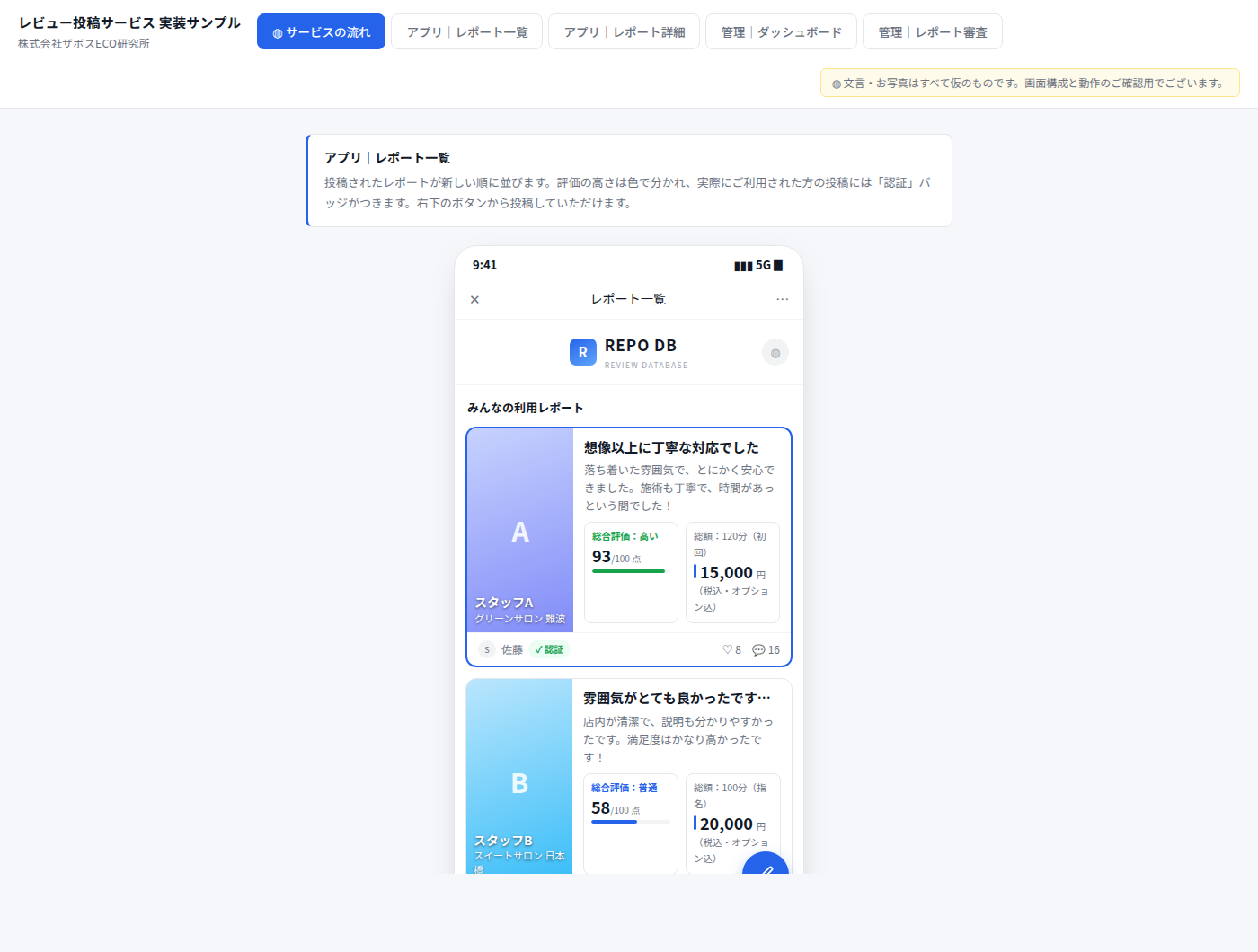
Four screens you can try
- App | Report list — newest first, rating levels distinguished by colour, with a verified badge on posts from people who actually used the service
- App | Report detail — analysis data, impression tags, Q&A and usage data on a single screen
- Admin | Dashboard — user count, post count, pending-review count, and how each is trending
- Admin | Report screening — send back, approve, or grant verified status, all from one screen
Why it is built this way
1. Screening in the same view as the published page
Submitted content is judged while displayed exactly as it will appear once published. When the admin side shows nothing but raw text, what the operator approved and what readers see start to diverge.
2. Every rejection carries a reason
A bare refusal leaves the contributor with no idea what to fix. Reports are returned with a reason attached. That single extra step is what changes the quality of what gets submitted.
3. Verification codes show real usage
Posts accompanied by the code handed to an actual customer are published with a verified badge. It gives readers something to go on.
4. Usable without an app store (PWA)
Added to the home screen, it works just like an app, and notifications for new reports or screening results can be delivered. No separate app development cost, no store registration.
About the foundation
Member registration, login, posting, comments, likes, my page, and on the admin side user management and approval workflow are already part of our own CMS, VosCMS. What has to be newly built narrows to the screens specific to this field and the screening flow itself. Less to build means a shorter schedule, a lower cost, and fewer defects.
All wording and photographs are placeholders. The sample exists so that the screen structure and behaviour can be confirmed.